
Three Roads to Higher Adult Development | InnerShift Leaderdhip
Three Roads to Higher Adult Development
Why Some People Need Healing, Some Need Skills, and Some Are Ready for the Next Stage of Leadership
In my previous article, I explored an important question:
What are we actually developing toward?
The adult-development models of Robert Kegan, Abraham Maslow, and Carl Jung give us remarkably complementary answers.
Kegan points toward the Self-Authoring and Self-Transforming Mind.
Maslow points toward self-actualization and ultimately self-transcendence.
Jung describes individuation and self-realization—the lifelong movement toward greater integration and wholeness around the Self.
Inner Shift translates these ideas into a simpler practical aspiration:
Grow beyond fear-based protection into love-based True Self Leadership.
But that raises another question:
How do we get there?
This is where my own journey taught me something important.
I gradually realized that people do not all begin their developmental journey from the same place.
...Beyond Self-Improvement: Adult Development, Self-Realization, and Where Inner Shift Stands
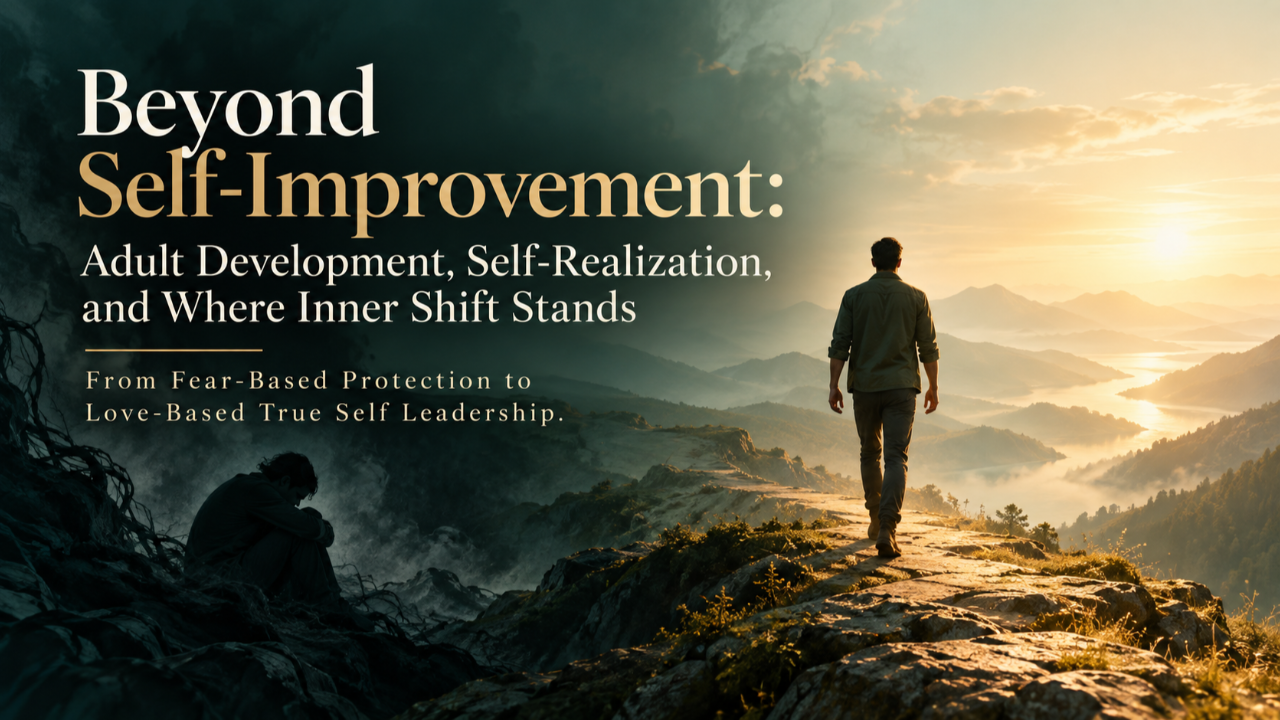
From Fear-Based Protection to Love-Based True Self Leadership
Most personal-development programs begin with a simple question:
How can I become better?
Adult-development psychology asks a deeper question:
Who am I becoming?
And perhaps an even deeper one:
From what level of consciousness, identity, and maturity am I living and leading my life?
That distinction is central to understanding Inner Shift.
Inner Shift is not primarily about becoming more productive, more positive, or even more successful.
And it is not an enlightenment program.
It is best understood as a practical system of adult development designed to help people move beyond fear-based, protective ways of living toward greater self-awareness, psychological flexibility, integration, inner authority, love, purpose, and True Self Leadership.
Across many of the most important theories of adult development, remarkably similar patterns appear.
Human development seems to move from:
dependence → autonomy → integration...
